Beyond Gradual Change: Exploring the Role of Sudden Catastrophes in Earth’s Geological History
Stand on a quiet beach, and the planet feels settled, almost sleepy. That calm is real, but it is only part of the picture, because Earth’s geological catastrophes have left their fingerprints on every continent we know. We have spent years studying how sudden events and slow processes work side by side, and the story gets richer when both are given room. Think of a river carving a canyon over thousands of years, then a single flood rearranging the whole valley in a week. Both are true, and each one teaches us something the other cannot.
Why Slow and Sudden Both Matter
Gradual change gave science some of its most beautiful ideas, and we respect that foundation deeply. Layers of rock, patient erosion, and drifting plates taught generations how to read the ground beneath their feet. What we add is a friendly invitation to ask what else the record might be telling us. We look at the solar system as a place where periodic events can reshape entire worlds, and we find that holding both views at once turns old puzzles into open doors. Take the raised continents, for example. Why does only our planet have them? Questions like that are where the fun begins for us.
Where Our Oceans May Have Come From
Water is the question people ask us most, and we love it. Earth is the only world we know of with liquid oceans on its surface, and that deserves a thoughtful explanation. An alternative theory of Earth’s water origin sits at the heart of our research, and it ties the arrival of water to the same dramatic events that shaped the Moon. We walk through it step by step in our Water Origins video. You do not need a science degree to follow along, only some curiosity and a willingness to look at familiar facts from a fresh angle, maybe with a cup of coffee in hand.
A Visitor the Size of Ganymede
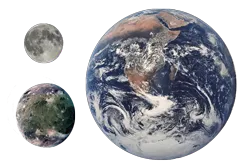
Picture a rogue body, roughly the size of Ganymede, crossing paths with the young Earth. In our telling, that encounter helped set the Earth and Moon on their shared orbit and changed the planet’s course for good. Our Genesis video follows that sequence for the Earth and Moon system specifically, and we keep that focus on purpose. Other videos on our site, including the ones on the Nemesis star and the Great Deluge, explore how periodic visitors from deep space may have returned over the ages. Watching it animated makes it click in a way paragraphs sometimes cannot, and we hear that from viewers all the time.
What We Look for in the Record
When we examine a possible sudden event, we keep a short checklist close at hand, and these are the clues that excite us most:
-
Abrupt shifts in rock layers that sit beside long, quiet stretches
-
Flood stories that appear in cultures far apart from one another
-
Raised continents and the timing of their first appearance
-
Impact scars and debris patterns across the inner solar system
-
Hints hidden in the Moon’s makeup and orbit
Reading the Record Together
None of this asks anyone to set aside good science. It simply widens the lens. Earth’s geological catastrophes, seen alongside gradual change, give us a fuller timeline, and that timeline helps explain why the main asteroid belt never became a planet and why humanity has lived through such dramatic chapters even within recorded history. We have noticed that readers who arrive skeptical often leave curious, which is exactly the spirit we hope to build. Questions are welcome here, and so are respectful challenges, because good ideas grow best when people test them together.
Conclusion
Behind this work is Doug Ettinger, a Pittsburgh author who studied mechanical engineering at Lehigh University and spent 22 years in nuclear engineering before turning his full attention to a question that has fascinated him since the mid-80s: the mystery of the Moon. That curiosity grew into three hypotheses we are proud to share, and we would love for you to explore them with us. Watch the videos, browse the theory pages, and reach out through our contact page with your thoughts. Visit Ettinger Journals today and see where your own curiosity leads.
FAQs
1. What are Earth’s geological catastrophes?
Earth’s geological catastrophes are sudden, large-scale events that can reshape landscapes, alter geological formations, and influence the planet’s development. Examples include massive floods, impacts, and significant changes to Earth’s crust.
2. How do sudden geological events differ from gradual geological processes?
Gradual processes, such as erosion and plate movement, occur over extended periods, while catastrophic events can produce significant changes in a relatively short time. Both offer valuable perspectives for understanding Earth’s geological history.
3. What is the alternative theory of Earth’s water origin discussed by Ettinger Journals?
Ettinger Journals explores a hypothesis connecting Earth’s water origins to dramatic planetary encounters during early solar system development, including events associated with the formation of the Earth-Moon system.
4. What role could planetary encounters have played in Earth’s geological history?
According to the hypotheses explored by Ettinger Journals, encounters with large celestial bodies may have influenced Earth’s formation, the Earth-Moon system, and subsequent geological changes.
5. How can I learn more about Ettinger Journals’ theories on Earth’s geological history?
You can explore the educational videos and theory pages on Ettinger Journals, including its research on the Genesis event, Water Origins, the Nemesis Star, and the Great Deluge. These resources offer further insight into its alternative explanations of Earth’s development.