Earth’s Geological Catastrophes: Exploring Periodic Catastrophism and the Violent History of the Earth-Moon System
Earth’s history is often described as a long sequence of gradual changes: continents shifting, mountains rising, oceans changing, and climates moving through cycles over immense stretches of time. Ettinger Journals examines a more disruptive possibility. Its research asks whether some of the planet’s most significant transformations were produced by extraordinary events occurring within relatively short periods. This idea is central to the study of Earth’s geological catastrophes and the theory of periodic catastrophism.
The premise is straightforward, even if the implications are anything but. What if Earth has not always existed within a quiet, predictable solar system? What if celestial encounters, powerful electrical interactions, crustal disturbances, and sudden changes in sea level have periodically altered the planet? Ettinger Journals explores these questions through a collection of hypotheses concerning Earth’s formation, the Moon, ancient catastrophes, the Great Deluge, and the broader evolution of the solar system.
A Different Way to Examine Earth’s Geological History
Ettinger Journals presents periodic catastrophism as an alternative to viewing planetary history entirely through slow, incremental processes. The website asks whether the solar system is truly pristine and unchanging or whether it has experienced recurring catastrophic episodes. That question matters because the proposed events are not minor geological disturbances. They involve changes that could affect Earth’s surface, climate, oceans, atmosphere, and even the relationship between Earth and the Moon.
The Great Deluge is one of the principal examples examined on the site. Ettinger’s research places the hypothesized catastrophe around the transition from the Pleistocene to the Holocene, during the period associated with the Younger Dryas. The proposed event is presented as part of a larger sequence of calamities rather than as an isolated flood. The study sees earthquakes, increased volcanism, elevation changes, shifts in river direction, ice-sheet disruption, and dramatic changes in sea level as linked developments.
This is where the idea of geological catastrophes on Earth comes into play. Instead of treating unusual geological features or ancient disasters as unrelated incidents, the hypothesis attempts to assemble them into one planetary sequence.
The Earth-Moon Connection
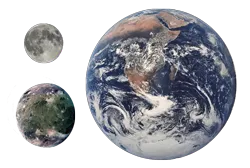
The theory becomes even more ambitious when the history of Earth is considered alongside the Moon. Ettinger Journals calls the relationship between these two bodies a “Moon enigma,” focusing on their unusual orbital and physical characteristics. Its research questions why the Earth and Moon occupy the same general solar orbit and why the Moon differs from conventional planetary satellites in several respects.
The site’s proposed answer is called Earth’s Metamorphosis, or EMM. According to this hypothesis, the young Earth was struck by a rogue planet while the solar system was already substantially established. The collision is proposed to have tilted Earth’s spin axis, altered its trajectory, disturbed its crust, and produced debris that eventually became associated with the asteroid belt. The hypothesis further proposes that Earth moved inward toward the Sun and ultimately entered an orbit shared with the Moon.
For readers interested in an Earth Moon Evolution Glossary, these ideas provide useful context for understanding the terminology surrounding planetary formation and celestial interactions. Ettinger Journals also maintains a dedicated reference section containing timelines, a glossary, and material concerning solar-system formation.
The Great Deluge as a Case Study in Catastrophism
The Great Deluge research offers the clearest illustration of how Ettinger connects different forms of planetary disruption. The website describes a proposed sequence beginning with celestial visitors and interactions involving the hypothesized Nemesis brown dwarf star and its planets. The research then considers increasing solar activity, electrical interactions, magnetic effects, and disturbances involving Earth’s crustal-mantle shell.
Within this framework, a major rotation of Earth’s crustal-mantle shell is proposed to have produced widespread surface disruption. The effects are described as including earthquakes, increased volcanism, elevation changes, lake runoffs, and altered river directions. The hypothesis then connects these disturbances with changes involving Antarctic ice and a substantial rise in ocean level.
Ettinger’s proposed sequence is deliberately broad. It attempts to account for geological formations, ancient flooding, ice-sheet behavior, and the destruction of ancient settlements within a single catastrophic framework. The website itself describes these interpretations as “speculative and highly controversial”. That qualification is important. These ideas are presented as hypotheses to challenge the scientific paradigm, and not as established scientific conclusions.
Why Periodic Catastrophism Remains an Interesting Question
The appeal of periodic catastrophism lies in the questions it raises. If major planetary events have occurred repeatedly, then Earth’s geological record may contain traces of episodes that were far more abrupt and extensive than conventional explanations suggest. Ettinger Journals approaches those questions by comparing ideas from Earth science, astronomy, physics, geography, archaeology, and natural history.
The site’s broader collection reflects this approach. Its research covers the Moon enigma, the Great Deluge, the Nemesis Star, Earth’s water, the first mega-continent, ancient civilizations, gravity, and the Genesis Project. These subjects are treated as interconnected pieces of a much larger investigation into Earth’s origins and its potentially turbulent history.
An Earth Moon Evolution Glossary can help readers navigate this territory, particularly when unfamiliar concepts from planetary science and astronomy appear alongside geological and historical questions. But the larger purpose is not simply vocabulary. It is to encourage readers to examine how different observations might fit into competing explanations of Earth’s past.
Final Take
Ettinger Journals takes a distinctly unconventional position: Earth’s history may include episodes of sudden, enormous disruption that deserve examination alongside gradual geological processes. Its theory of periodic catastrophism brings celestial events, crustal movement, flooding, volcanism, ice-sheet changes, and the unusual Earth-Moon relationship into one broad hypothesis.
Whether readers ultimately accept or reject these ideas, the questions are difficult to ignore. Some of the most important questions that are explored throughout Ettinger’s work are the geological catastrophes of the Earth, particularly as they relate to the theorized evolution of the Earth-Moon system. For those interested in an Earth-Moon Evolution Glossary, Ettinger Journals offers a collection of theories, timelines, and research to challenge the orthodox accounts and encourage a more thorough investigation into the remarkable history of Earth.
FAQs
1. What are Earth’s geological catastrophes?
Earth’s geological catastrophes are proposed large-scale events involving flooding, earthquakes, volcanism, crustal changes, and other sudden planetary disruptions.
2. What is periodic catastrophism?
Periodic catastrophism proposes that Earth undergoes major disruptive events that produce significant geological and environmental changes.
3. What does Ettinger Journals say about the Great Deluge?
Ettinger Journals explores the Great Deluge as a proposed ancient catastrophe involving flooding, crustal disruption, volcanism, and environmental changes.
4. How does the Moon relate to Earth’s geological history?
Ettinger Journals examines the Earth-Moon relationship through theories concerning planetary formation, celestial interactions, orbital changes, and Earth’s early development.
5. Where can readers learn about Earth-Moon Evolution Glossary concepts?
Ettinger Journals provides research, timelines, and glossary material covering planetary formation, celestial interactions, Earth’s evolution, and related astronomical concepts.