Exploring a Scientific Explanation of Genesis Through Earth’s History
Every civilization has asked how the world began, but what if the opening lines of one of the oldest texts on record were quietly describing an actual planetary event? At Ettinger Journals, we came across a book that does exactly that. It offers a genuine scientific explanation of Genesis by tracing the biblical account of creation back to a real, catastrophic moment in Earth’s early history. It is a striking piece of research, and once you see the parallels laid out, it is hard to look at the opening chapter of the Bible the same way again.
A Book Worth Buying and Reading Slowly
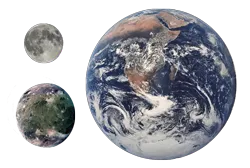
The research comes from a book by Douglas Edinger, available on Amazon, and it is worth purchasing if this topic interests you even slightly. Edinger builds his case by combining two separate scientific ideas that most readers have never seen placed side by side. One is the long-standing suggestion that the Moon may once have been its own terrestrial planet.
The other comes from modern computer simulations, which point to a missing planet in what is now the asteroid main belt, lost to a planetary collision billions of years ago. Edinger’s contribution is connecting these two threads into a single, coherent origin story for Earth as we know it.
Earth’s Lucky Starting Position
Long before this collision took place, Earth sat in a cooler orbit beyond Mars during the Sun’s early development. That position mattered enormously. It allowed the young planet to hold onto liquid water and the nitrogen and carbon dioxide that made up its early atmosphere, something the other inner planets simply could not manage.
Earth, in other words, started out in the right neighborhood at the right time.
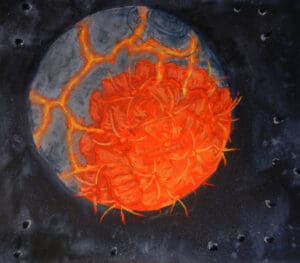
About the Image:- The escaping ejecta and deep engorgement of young Earth’s very molten mantle create the asteroid belt and an ejected planet. Much of the kinetic energy of the collision was transferred to Earth’s orbital displacement sunward, where this gorged body, with its debris, merged with the Moon’s orbit.
The Collision That Changed Everything
As the space around the young Sun cooled further, Earth’s still-molten mantle was struck by a smaller, icy rogue planet. The impact sent Earth spiraling sunward, gaining momentum until it settled into a new orbit closer to an existing inner planet, the body we now know as the Moon.
Over time, Earth’s faster orbit slowed to match the Moon’s, and as angular momentum balanced out, the Moon drifted farther away and settled into the steady, synchronized dance around Earth that we still observe tonight.
Where the Firmament Comes From
This single, violent event, according to the book, lines up remarkably well with the earliest verses of Genesis. The first supercontinent, formed from the resulting global impact crater and surrounded by oceans and thick atmospheric water vapor, is what the Bible refers to as the firmament.
Read that way, an ancient text starts sounding less like myth and more like a distant memory of a real geological turning point.
Two Lights in the Sky
Genesis describes a light for the day and a light for the night, and the book offers a fittingly literal explanation. The impact pulled Earth into a closer, warmer orbit around a brighter Sun, while the newly captured Moon began reflecting that same sunlight back at night. Without this collision, the story goes, Earth would have stayed a cold, watery world circling a Sun that appeared no larger than a distant star.
There would have been no clear day, no true night, and no Moon overhead at all.
Answering the Big Mysteries
What makes this scientific explanation of Genesis genuinely compelling is how many long-standing planetary puzzles it addresses in one sweep. Why do Earth and the Moon share such a closely linked orbital history? Where did the asteroid main belt actually come from? Why did the inner solar system experience a late heavy bombardment early on? Why was the first supercontinent lifted above a global ocean, cracking into rifts across its surface?
And perhaps most importantly, where did Earth’s liquid water come from in the first place, the very water that powers the rock cycle, shapes sedimentary and metamorphic rock through plate tectonics, volcanism, and weathering, and eventually builds the atmospheric oxygen and nitrogen that life depends on?
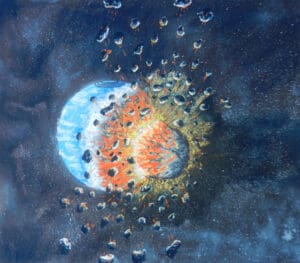
About the Image:- The bloating of Earth caused its crust to expand and globally crack, creating the first major plate tectonics and volcanism in the young solar system. This volcanism replenished volatiles on Earth’s surface that were infused and trapped in the mantle.
Why This Matters Beyond the Science
None of this is presented as a replacement for faith or for geology. It is presented as a bridge between them, a way of reading an ancient text with fresh eyes while taking planetary science seriously. Whether you come to this book as a believer curious about scientific grounding or as a science reader curious about ancient texts, there is something here worth sitting with.
Ettinger Journals is always drawn to research that connects fields people rarely think to combine, and this is a strong example of that kind of thinking.
Final Thoughts
Earth’s history is written in its rocks, its orbit, and apparently, according to this research, in one of humanity’s oldest stories as well. This scientific explanation of Genesis does not ask you to abandon either science or scripture. It asks you to look at both a little more closely and notice where they might actually be describing the same event from two very different angles.
If that kind of question keeps you up at night the way it did for us, the book is worth tracking down, and Ettinger Journals will keep exploring ideas like this one, wherever they lead.
FAQs
1.What is a scientific explanation of Genesis?
A scientific explanation of Genesis is an attempt to interpret the biblical creation account through scientific concepts such as planetary formation, Earth’s history, geology, and astronomy.
2.How does Earth’s history relate to Genesis?
The proposed interpretation connects events in Earth’s early history, including planetary changes, the formation of land and oceans, and atmospheric development, with descriptions found in Genesis.
3.What role does the Moon play in this interpretation of Genesis?
The Moon is central to the proposed theory, which suggests that an ancient planetary event influenced Earth’s orbit and the Moon’s relationship with Earth.
4.Does the theory suggest that Earth was once in a different orbit?
Yes. The theory presented in the book proposes that early Earth originally occupied a cooler orbit farther from the Sun before a major planetary collision altered its trajectory.
5.What is the proposed connection between the asteroid belt and Genesis?
The theory connects the asteroid belt to the remains of a planetary collision and suggests that this event may help explain some of the large-scale changes described in the Genesis account.