How the Earth-Moon Relationship Connects to a Scientific View of Genesis
The Moon’s place in Earth’s sky may seem like a simple fact, but its relationship with our planet raises some of the biggest questions about Earth’s early history. How did the two bodies become connected, and what changes allowed Earth to develop into the world we know today? Douglas Edinger’s proposed theory takes those questions in an unusual direction by examining them alongside the creation account in Genesis.
Rather than treating science and scripture as entirely separate subjects, the theory explores whether Earth’s orbital history, the Moon, early geological changes, and the biblical description of creation could be connected. This approach offers a different way to examine the Earth-Moon Genesis while considering what Genesis may have been describing in its own language.
The Book Behind the Idea
This research comes from a book by Douglas Edinger, available on Amazon and worth buying if the subject grabs you. Edinger merges two existing scientific ideas that rarely get placed side by side. The first treats the Moon as a body that may once have been its own terrestrial planet.
The second comes from modern computer simulations, which suggest the asteroid main belt is missing a planet, lost long ago in a violent collision. Bringing these two ideas together is what gives the theory its shape.
Earth’s Early Advantage
Before any of this happened, Earth sat in a cooler orbit beyond Mars while the Sun was still young. That distance gave Earth something the other inner planets never got: the ability to hold onto liquid water along with nitrogen and carbon dioxide in its atmosphere.
Earth was simply positioned better than its neighbors, and that early advantage set up everything that came after.
The Impact That Reshaped Earth
As the region around the young Sun cooled, Earth’s molten mantle was struck by a smaller, icy rogue planet. The force of that impact sent Earth spiraling closer to the Sun, gaining momentum until it locked into a new orbit near another inner planet, the body we call the Moon today. Earth’s orbit then slowed to match the Moon’s, and as angular momentum balanced between the two, the Moon drifted outward into the steady rhythm it still follows around Earth.
Two Lights, One Explanation
Genesis speaks of a light to rule the day and a light to rule the night, and this is where the theory becomes genuinely striking. The collision pulled Earth into a warmer, closer orbit around a brighter Sun, giving the planet real daylight for the first time. At night, the newly captured Moon reflected that same sunlight back down to Earth.
Without this event, the story goes, Earth would have stayed distant and cold, circling a Sun no bigger in the sky than an ordinary star, with no true day, no true night, and no Moon at all.
Where the Firmament Fits In
The book connects the resulting global impact crater, along with the first supercontinent and the oceans and water vapor surrounding it, to what Genesis calls the firmament. Seen through this lens, an ancient verse starts to read less like poetry and more like a record of an actual planetary transformation, passed down long before anyone understood the science behind it.
The Bigger Questions It Answers
What makes Earth Moon Genesis worth taking seriously is how many separate mysteries it addresses at once. Why do Earth and the Moon share such a closely tied orbital history? Where did the asteroid main belt actually come from? Why did the inner solar system go through a late heavy bombardment early in its history? Why was the first supercontinent pushed above the global ocean, leaving rifts cracked across its surface?
And where did Earth’s liquid water originate, the same water that drives the rock cycle, shapes sedimentary and metamorphic rock through plate tectonics, volcanism, and weathering, and eventually leads to the atmospheric oxygen and nitrogen that life needed to appear at all?
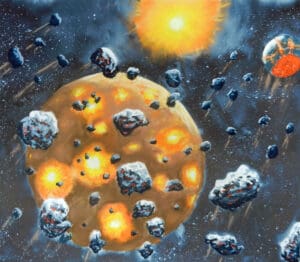
About the Image:- The planet beyond Mars now transforms into Planet Earth by falling sunward, increasing velocity, and developing enough centripetal force to share the Moon’s orbit and bring collisional debris that batters the Moon’s surface. Their combined local gravity forces caused tidal acceleration forces that slowed Earth over thousands of passing orbits to match the Moon’s orbital velocity, and then allowed the Moon to move away, starting an orbital synchrony that in turn began Earth’s stable tilted spin axis and the continental drift process. The mystery of two planets sharing one orbit is resolved.
Why It’s Worth Your Attention
This is not an attempt to replace faith with physics or the other way around. It is an attempt to show that they might be pointing at the same moment in Earth’s past, described in two completely different languages, one written in rock and orbit, the other in verse.
Ettinger Journals is always interested in ideas that bring separate fields into the same conversation, and this one does that in a way that stays with you.
Final Thoughts
Earth’s history sits quietly in its rocks, in the Moon overhead, and, according to this theory, in one of the oldest stories ever written down. Earth Moon Genesis is not a demand to pick a side between science and scripture. It is an invitation to look at both a little more carefully and notice how closely they might actually line up.
If that question interests you as much as it interests us, the book is worth seeking out, and Ettinger Journals will keep digging into ideas like this one wherever they take us.
FAQs
1.What is the connection between the Earth, Moon, and Genesis?
The proposed theory connects the Earth-Moon system to the Genesis creation account by interpreting a major planetary event as a possible explanation for descriptions of the Sun, Moon, land, and water.
2.What does the Earth-Moon Genesis theory propose?
It proposes that a major planetary collision changed Earth’s orbit and influenced the Moon’s relationship with Earth, creating conditions that the author connects with the Genesis account.
3.Was the Moon once considered a separate terrestrial planet?
The theory discussed in the blog treats the Moon as a body that may once have existed as a separate terrestrial planet before becoming associated with Earth.
4.How does the theory explain the Moon’s relationship with Earth?
According to the proposed model, a planetary collision altered Earth’s orbit and its relationship with the Moon, while changes in angular momentum contributed to the Moon moving farther from Earth.
5.How does Genesis describe the Sun and Moon?
Genesis describes a greater light associated with the day and a lesser light associated with the night, which this theory interprets in relation to the Sun and Moon.
6.What role does a planetary collision play in this theory?
The theory proposes that an impact between early Earth and a smaller icy planetary body changed Earth’s orbit and contributed to the Earth-Moon configuration.